Category

Aktuelt

Støtteskriv fra Norsk flygelederforening

By | Aktuelt

To: The European Committee of Social Rights

Department of Social Rights

Directorate General Human Rights and Rule of Law,

Council of Europe

F-67075 Strasbourg Cedex

E-mail: DGF-ESC-Collective-Complaints@coe.int

Statement of Support to two pending complaints

Your reference — / Our reference RG/EC-SR/26 Date 19.06.2026

This is a supportive letter in support of complaints 238/2024 (SMB Norge) and 263/2026

(FFFS), delivered independently by Norwegian Air Traffic Controllers Association (NATCA),

with individual rights to file complaints.

NATCA is both a professional association that works to inspire the development of the air

traffic controller profession and a trade union in the collective bargaining context. The

association has approximately 550 members which is close to 100% of all air traffic

controllers in Norway.

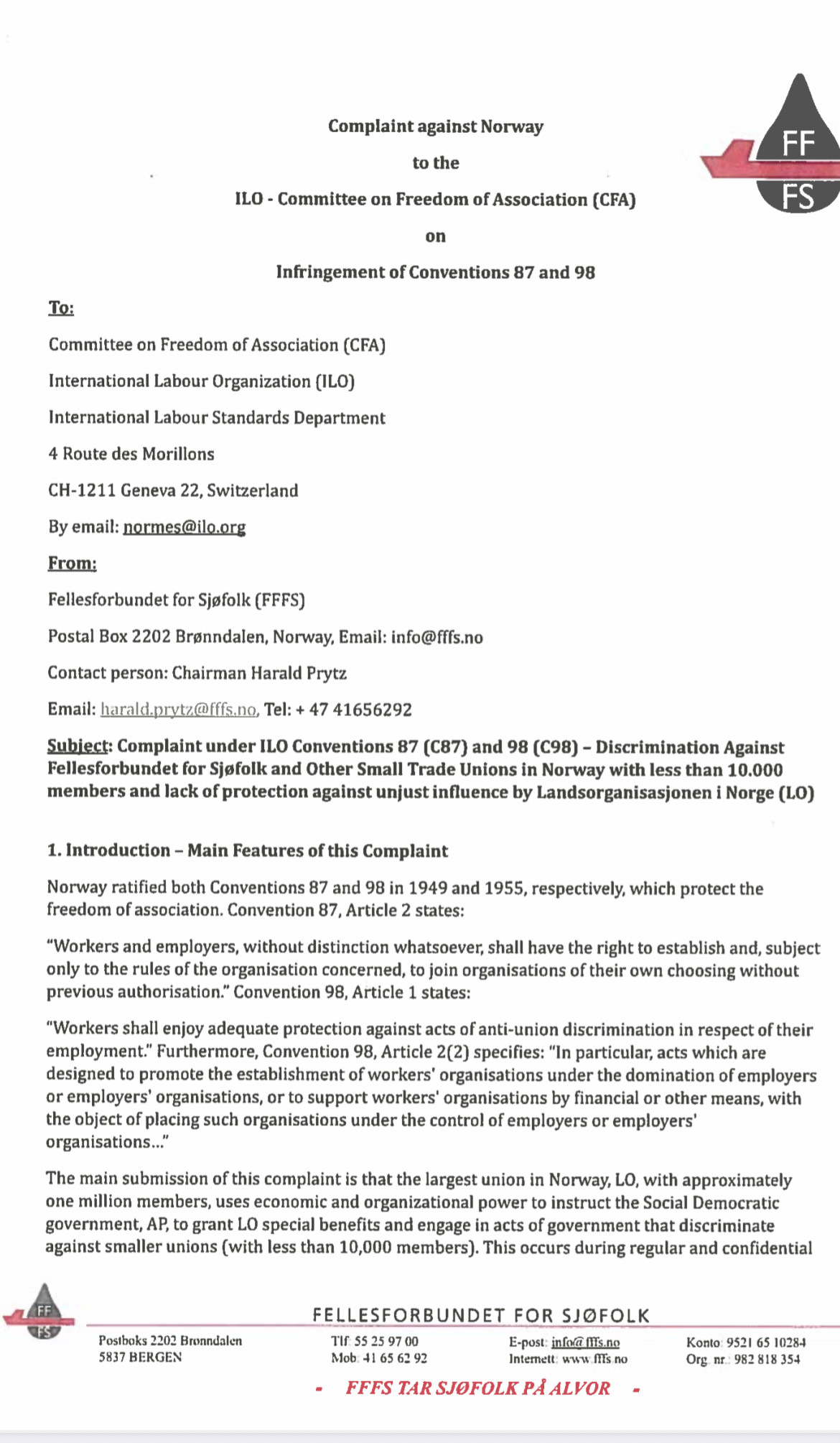
NATCA refers to the complaint submitted by Fellesforbundet for Sjøfolk, FFFS, to the

European Committee of Social Rights concerning an alleged violation of Article 5 of the

Revised European Social Charter. FFFS has submitted the complaint as an independent trade

union in Norway, and the complaint has been submitted as a separate complaint in support of

complaint no. 238/2024 from SMB Norge concerning the same matter.

In our view, the case raises important questions of principle concerning freedom of

association, equal treatment unions, and the genuine ability of smaller trade unions to

safeguard their members´ interests. FFFS argues that freedom of association under Article 5

must be practical and effective, and that a legal framework which favours large trade unions

and makes smaller trade unions less effective may weaken that right.


NATCA shares this view. Freedom of association should not merely protect the right to

establish and join a trade union in a formal sense. It must also protect employees´ genuine

ability to choose a trade union that can in fact represent them effectively in employment law

matters – not depended of the size of the association/union.


As a smaller, profession-based trade union, NATCA is particularly concerned that employees

should be able to organize on the basis of their own professional, occupational and

democratic preferences. For employees in specialized professions, it may be essential to have

a trade union that understands the particular responsibilities, working methods, safety

requirements and professional challenges of the profession. If legislation grants large

confederation special rights that smaller trade unions cannot obtain, this may weaken the

value of such free choice of association, and it does not cater for the real democratic rights

and the real freedom of speech.

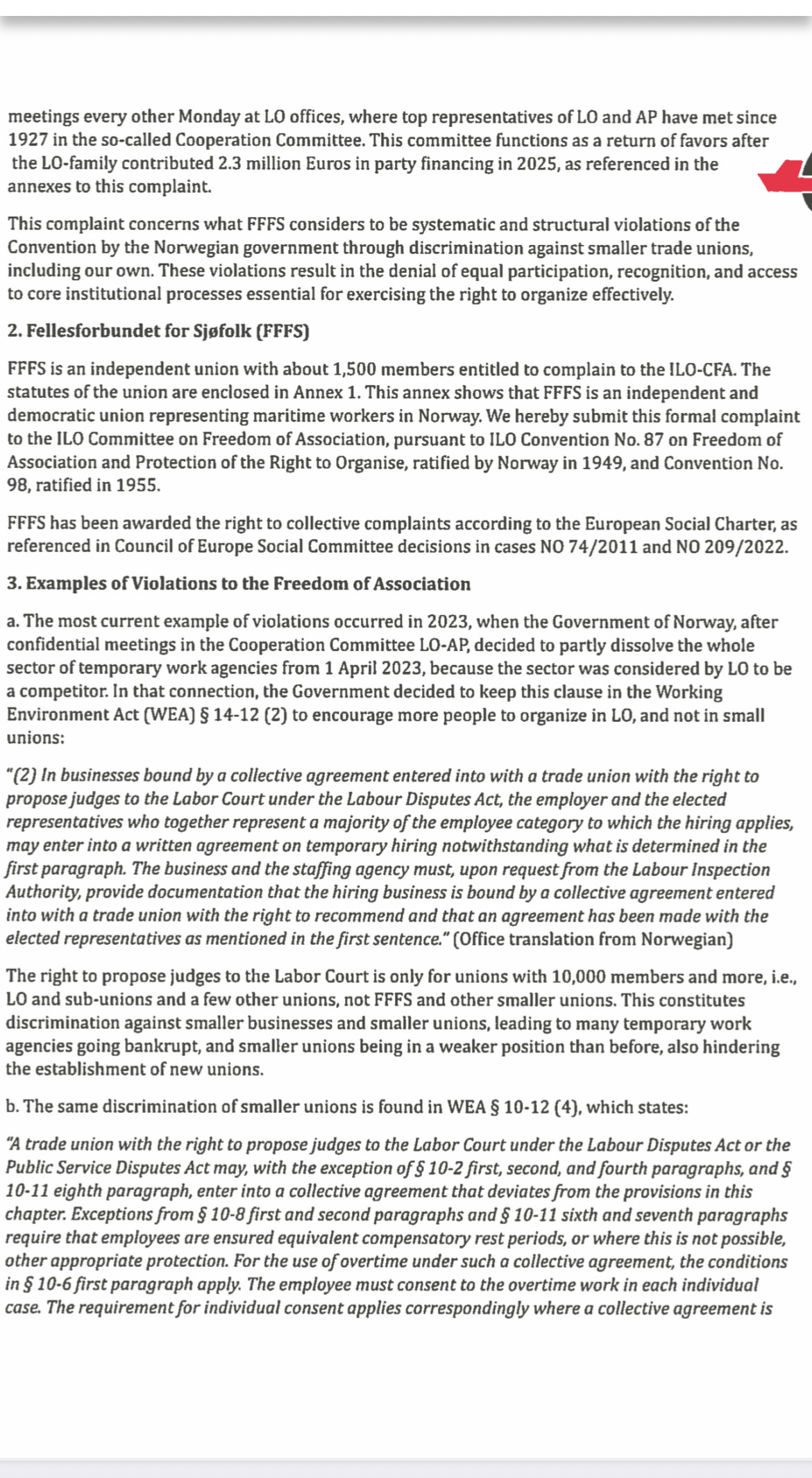
In its complaint, FFFS points, among other things, to rules under which rights are linked to

trade unions with at least 10 000 members. FFFS refers among other things, to section 39 of

the Labour Disputes Act, which according to the complaint only gives trade unions with at

least 10 000 members the right to propose judges to the Labour Court. FFFS further argues

that FFFS, with approximately 1 500 members, is thereby excluded, and that the threshold

gives large trade unions influence over the composition of the Labour Court. This may

contribute to weakening legal certainty for certain professional groups.


NATCA considers that such thresholds and arrangements should be carefully assessed

against the right to freedom of association. Where rights and institutional influence are linked

to membership thresholds that smaller and profession-based trade unions cannot meet in

practice, this may create an employment lay system in which smaller trade unions become

less effective than others, not because of the members´ free choice, but because of statutory

advantages.


As FFFS points out, section 10-12 of the Working Environment Act only permits trade unions

with nomination rights, meaning at least 10 000 members, to enter into agreements that

derogate from the statutory rules on working time. FFFS argues that this creates a structural

incentive for both employees and employers to prefer large trade unions, because smaller

trade unions cannot offer equivalent bargaining strength. NATCA shares this concern.

Norsk Flygelederforening, Dronning Eufemias gate 16, 0191 Oslo. Org. nr: 980 018 067.

office@natca.no www.natca.no


Working time rules can be of great practical importance to employees and undertakings.

Where only trade unions above a certain size may enter into certain types of agreements,

employers may have a practical incentive to prefer larger organizations. Employees may

likewise experience that membership of a smaller trade union gives weaker practical effect,

even if the smaller trade union is otherwise the organization that best safeguards their

occupational and professional interests.


As FFFS also points out, it follows from section 14-12 of the Working Environment Act that

agreements concerning hiring from temporary-work agencies are reserved for trade unions

with at least 10 000 members. FFFS argues that smaller trade unions are therefore excluded

from this regulatory framework, and that this reinforces unequal treatment and favours

larger trade unions, particularly LO. NATCA supports FFFS´ view on this point.

NATCA considers that such rules cannot be assessed in isolation as technical threshold

provisions. They must be assessed by reference to their overall effect on freedom of

association and general democratic rights. If legislation makes it more advantageous for

employers and employees to deal with large trade unions, this may in practice weaken

smaller trade unions´ ability to grow, recruit members and represent employees effectively.

FFFS also refers to the fact that Article 5 protects both positive freedom of association,

meaning the right to join a trade union, and negative freedom of association, meaning the

right not to join a particular trade union. FFFS argues that if legal structures make certain

trade unions substantially less effective, employees may be indirectly pressured into joining

larger organizations. NATCA considers this to be a central point of the case.

NATCA is particularly concerned that freedom of association must be real. An employee

should not have to choose a trade union on the basis of which organization the State has

granted the most practical rights. The employee should be able to choose an organization on

the basis of trust, professional affiliation, occupational community, political independence and

democratic conviction.

FFFS further argues that the disputed legal framework must be assessed in light of a broader

institutional context in which LO enjoys privileged political access. FFFS argues that the main

basis for the complaint is structural preferential treatment of LO, which is described in the

complaint as an organization to the Labour Party. FFFS also refers to regular meetings

between LO and the Labour Party through the LO-AP Cooperation Committee.


NATCA considers it important that the European Committee of Social Rights assess both the

specific statutory provisions and the overall effect of these arrangements. Individual

provisions may appear neutral of technical when viewed separately, but collectively they may

contribute to giving large trade unions a special position with which smaller and independent

trade unions cannot compete on equal terms.


This is particularly important for smaller, independent and profession-based trade unions.

Such trade unions may be of great importance to their members, even if their membership

numbers cannot be compared with those of the largest confederations. The significance of a

trade union should not be measured only by numbers of its members, but also by its ability to

represent a particular occupational group, safeguard its members´ interests and participate

in a diverse and democratic working life.

NATCA therefore supports FFFS´ view that a system which grants large trade unions special

rights and gives smaller trade unions a weaker legal position may restrict employees´ genuine

free choice of trade union. This applies particularly where the rights reserved for large trade

unions concern central employment law issues such as working time, hiring-in, representation

and influence in employment law institutions.

NATCA considers that the State must ensure that freedom of association under Article 5 of

the Revised European Social Charter is practical and effective for all employees and all trade

unions, not only the largest organizations. If smaller trade unions may formally exist, but in

practice do not have access to key rights and instruments, freedom of association may

become illusory for those employees who wish to organize outside the largest confederations.

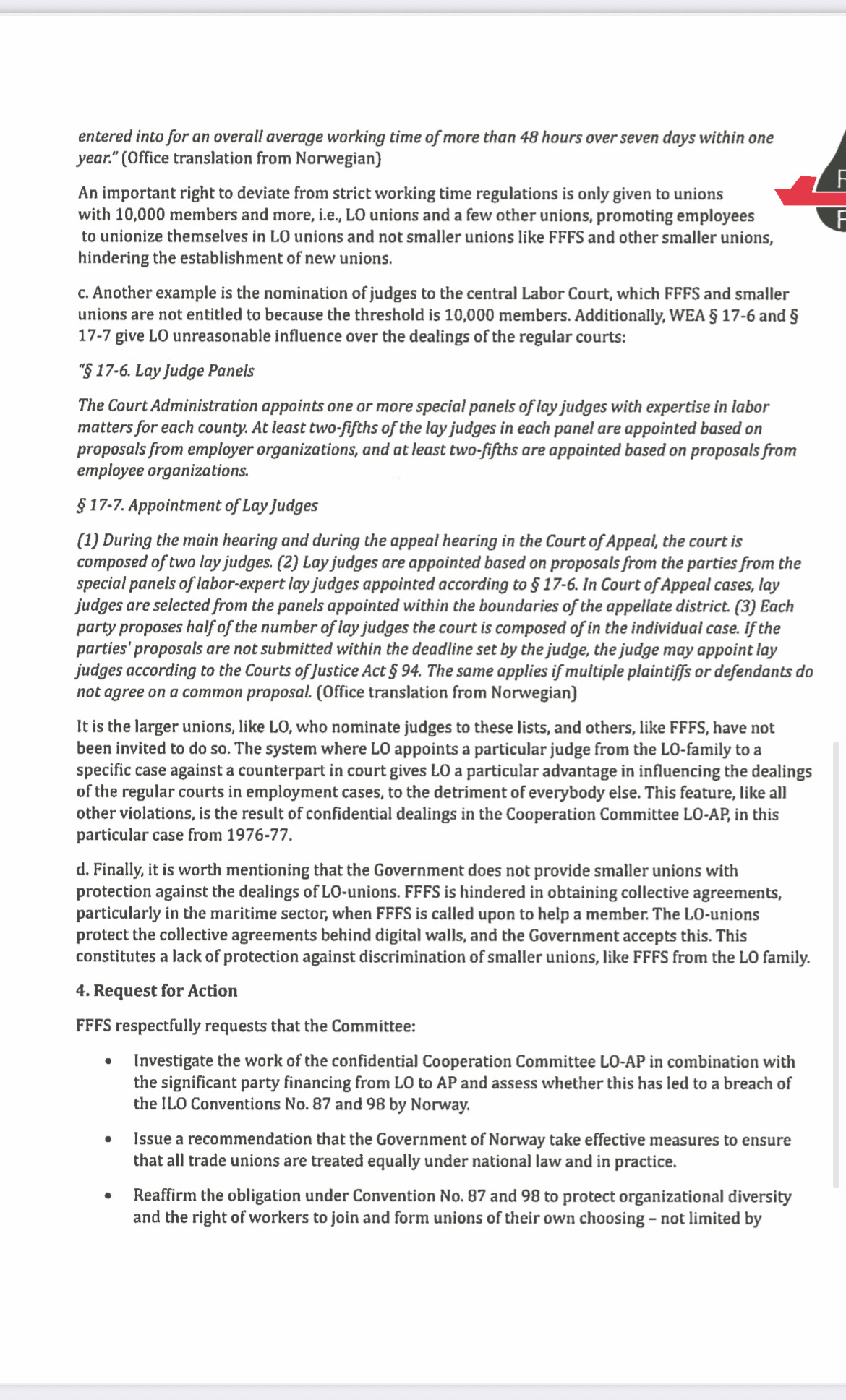
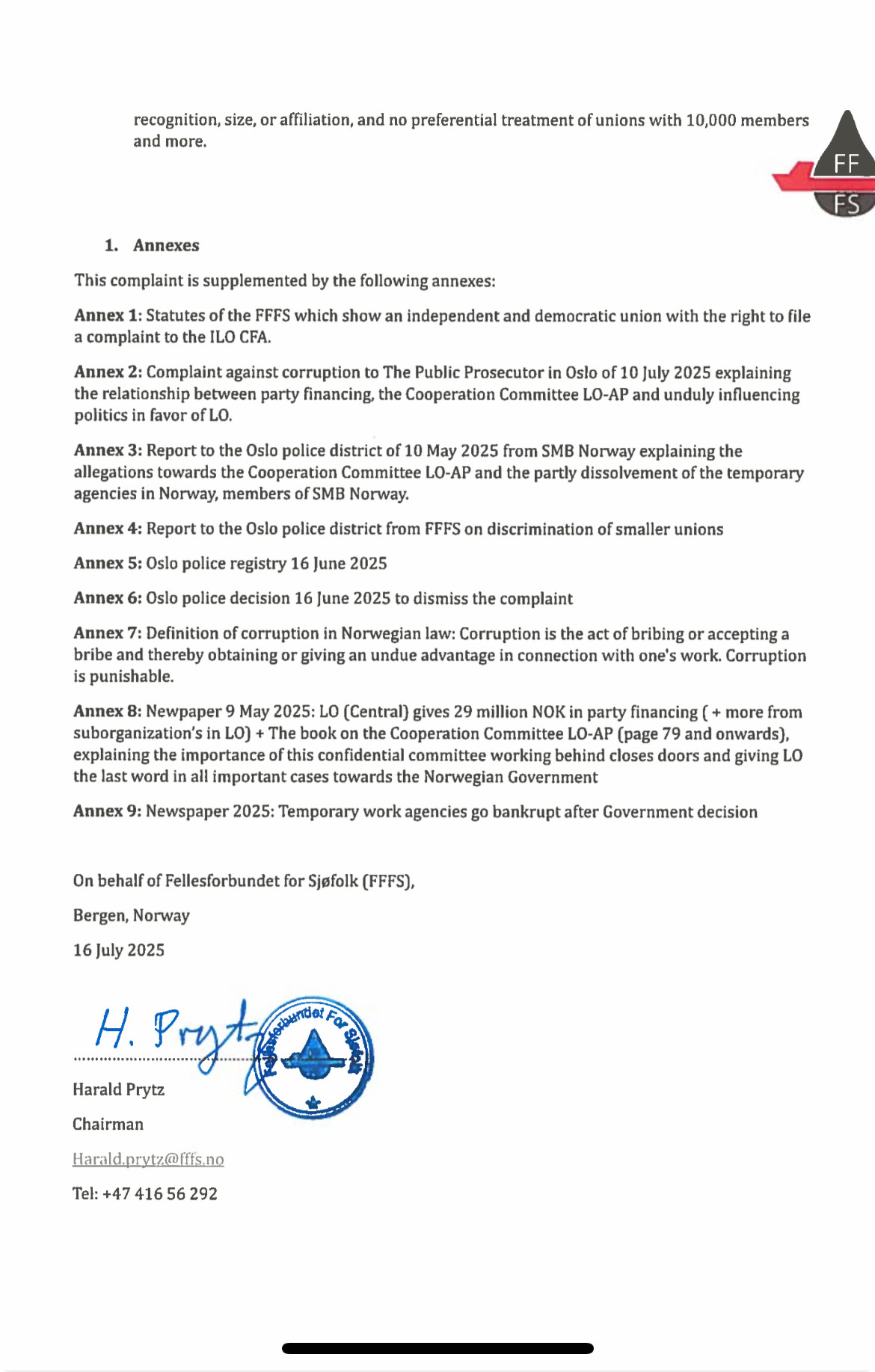
NATCA supports FFFS´ request that the European Committee of Social Rights conclude that

Norway is in breach of Article 5 of the Revised European Social Charter by granting

Landsorganisasjonen I Norge, LO, preferential treatment in Norwegian legislation and in

Norwegian courts.

Norsk Flygelederforening, Dronning Eufemias gate 16, 0191 Oslo.

Org. nr: 980 018 067. office@natca.no www.natca.noOn this basis, NATCA request that the conclusions of SMB Norge’s complaint (238/2024) and

FFFS´ (263/2026) complaint be upheld.

Yours sincerely

Robert Gjønnes / President / www.natca.no

Norsk Flygelederforening, Dronning Eufemias gate 16, 0191 Oslo. Org. nr: 980 018 067. office@natca.no www.natca.no
Støtteskriv fra Norskflyteknikerorganisajon til Europarådet

By | Aktuelt

To: The European Committee of Social Rights
Department of Social Rights

Directorate General Human Rights and Rule of Law,

Council of Europe

F-67075 Strasbourg Cedex

E-mail: DGF-ESC-Collective-Complaints@coe.int DATE: 10. Sept. 2026

From: Norsk Flyteknikerorganisasjon

Dronning Eufemias gate 16, Oslo, Norway

oRice@natca.no

AMICUS CURIE

1 Statement of Support to two pending complaints

This is a supportive letter in support of complaints 238/2024 (SMB Norge) and 263/2026

(FFFS), delivered independently by Norsk Flyteknikerorganisasjon, with individual rights to file

complaints.

Norsk Flyteknikerorganisasjon is both a professional association that works to foster

understanding and cohesion among members, promote positive cooperation, and strengthen

mutual trust between the union and employers and a trade union in the collective bargaining

context. The association has approximately 600 members.

Norsk Flyteknikerorganisasjon refers to the complaint submitted by Fellesforbundet for

Sjøfolk, FFFS, to the European Committee of Social Rights concerning an alleged violation of

Article 5 of the Revised European Social Charter. FFFS has submitted the complaint as an

independent trade union in Norway, and the complaint has been submitted as a separate

complaint in support of complaint no. 238/2024 from SMB Norge concerning the same

matter.In our view, the case raises important questions of principle concerning freedom of

association, equal treatment unions, and the genuine ability of smaller trade unions to

safeguard their members´ interests. FFFS argues that freedom of association under Article 5

must be practical and eRective, and that a legal framework which favors large trade unions

and makes smaller trade unions less eRective may weaken that right.

Norsk Flyteknikerorganisasjon shares this view. Freedom of association should not merely

protect the right to establish and join a trade union in a formal sense. It must also protect

employees´ genuine ability to choose a trade union that can in fact represent them eRectively

in employment law matters.

As a smaller, profession-based trade union, Norsk Flyteknikerorganisasjon is particularly

concerned that employees should be able to organize on the basis of their own professional,

occupational and democratic preferences. For employees in specialized professions, it may

be essential to have a trade union that understands the particular responsibilities, working

methods, safety requirements and professional challenges of the profession. If legislation

grants large confederation special rights that smaller trade unions cannot obtain, this may

weaken the value of such free choice of association.

In its complaint, FFFS points, among other things, to rules under which rights are linked to

trade unions with at least 10 000 members. FFFS refers among other things, to section 39 of

the Labour Disputes Act, which according to the complaint only gives trade unions with at

least 10 000 members the right to propose judges to the Labour Court. FFFS further argues

that FFFS, with approximately 1 500 members, is thereby excluded, and that the threshold

give large trade unions influence over the composition of the Labour Court.

Norsk Flyteknikerorganisasjon considers that such thresholds and arrangements should be

carefully assessed against the right to freedom of association. Where rights and institutional

influence are linked to membership thresholds that smaller and profession-based trade

unions cannot meet in practice, this may create an employment lay system in which smaller

trade unions become less eRective than others, not because of the members´ free choice,

but because of statutory advantages.As FFFS points out, section 10-12 of the Working Environment Act only permits trade unions

with nomination rights, meaning at least 10 000 members, to enter into agreements that

derogate from the statutory rules on working time. FFFS argues that this creates a structural

incentive for both employees and employers to prefer large trade unions, because smaller

trade unions cannot oRer equivalent bargaining strength. Norsk Flyteknikerorganisasjon

shares this concern.

Working time riles can be of great practical importance to employees and undertakings.

Where only trade unions above a certain size may enter into certain types of agreements,

employers may have a practical incentive to prefer larger organizations. Employees may

likewise experience that membership of a smaller trade union gives weaker practical eRect,

even if the smaller trade union is otherwise the organization that best safeguards their

occupational and professional interests.

As FFFs also points out, it follows from section 14-12 of the Working Environment Act that

agreements concerning hiring from temporary-work agencies are reserved for trade unions

with at least 10 000 members. FFFS argues that smaller trade unions are therefore excluded

from this regulatory framework, and that this reinforces unequal treatment and favors larger

trade unions, particularly LO. Norsk Flyteknikerorganisasjon supports FFFS´ view on this

point.

Norsk Flyteknikerorganisasjon considers that such rules cannot be assessed in isolation as

technical threshold provisions. They must be assessed by reference to their overall eRect on

freedom of association. If legislation makes it more advantageous for employers and

employees to deal with large trade unions, this may in practice weaken smaller trade unions´

ability to grow, recruit members and represent employees eRectively.

FFFS also refers to the fact that Article 5 protects both positive freedom of association,

meaning the right to join a trade union, and negative freedom of association, meaning the

right not to join a particular trade union. FFFS argues that if legal structures make certain

trade unions substantially less eRective, employees may be indirectly pressured into joining

larger organizations. Norsk Flyteknikerorganisasjon considers this to be a central point of the

case.Norsk Flyteknikerorganisasjon is particularly concerned that freedom of association must be

real. An employee should not have to choose a trade union on the basis of which organization

the State has granted the most practical rights. The employee should be able to choose an

organization on the basis of trust, professional aRiliation, occupational community, political

independence and democratic conviction.

FFFS further argues that the disputed legal framework must be assessed in light of a broader

institutional context in which LO enjoys privileged political access. FFFS argues that the main

basis for the complaint is structural preferential treatment of LO, which is described in the

complaint as an organization to the Labour Party. FFFS also refers to regular meetings

between LO and the Labour Party through the LO-AP Cooperation Committee.

Norsk Flyteknikerorganisasjon considers it important that the European Committee of Social

Rights assess both the specific statutory provisions and the overall eRect of these

arrangements. Individual provisions may appear neutral of technical when viewed separately,

but collectively they way contribute to giving large trade unions a special position with which

smaller and independent trade unions cannot compete on equal terms.

This is particularly important for smaller, independent and profession-based trade unions.

Such trade unions may be of great importance to their members, even if their membership

numbers cannot be compared with those of the largest confederations. The significance of a

trade union should not be measured only by numbers of its members, but also by its ability to

represent a particular occupational group, safeguard its members´ interests and participate

in a diverse and democratic working life.

Norsk Flyteknikerorganisasjon therefore supports FFFS´ view that a system which grants large

trade unions special rights and gives smaller trade unions a weaker legal position may restrict

employees´ genuine free choice of trade union. This applies particularly where the rights

reserved for large trade unions concern central employment law issues such as working time,

hiring-in, representation and influence in employment law institutions.

Norsk Flyteknikerorganisasjon considers that the State must ensure that freedom of

association under Article 5 of the Revised European Social Charter is practical and eRective

for all employees and all trade unions, not only the largest organizations. If smaller trade

unions may formally exist, but in practice do not have access to key rights and instruments,freedom of association may become illusory for those employees who wish to organize

outside the largest confederations.

Norsk Flyteknikerorganisasjon supports FFFS´ request that the European Committee of

Social Rights conclude that Norway is in breach of Article 5 of the Revised European Social

Charter by granting Landsorganisasjonen I Norge, LO, preferential treatment in Norwegian

legislation and in Norwegian courts.

On this basis, Norsk Flyteknikerorganisasjon request that the conclusions of SMB Norge’s

complaint (238/2024) and FFFS´ (263/2026) complaint be upheld.

Yours sincerely

Jan Skogseth

President

Norsk Flyteknikerorganisasjonlig

FFFS Klager på henleggelse til Statsadvokaten

By | Aktuelt

KLAGE TIL

OSLO STATSADVOKATEMBETE/RIKSADVOKATEN

Klage over henleggelse av anmeldelse mot LO/Samarbeidskomiteen LO-AP for

korrupsjon i forbindelse med partifinansiering og konfidensielle gjenytelsesmoter hver

14. dag i Folkets Hus mellom ledelsen i de to organisasjonene

Pr. e-post via Oslo politidistrikt: post.oslo(dpolitie1.no og post.vest(&poliliet.no

Kopi økokrim: post.okokrim&politiet,no og postmottak.riks(dtiksadvokuten.no

Det ble fra Fellesforbundet for Sjøfolk (FFFS) sendt inn anmeldelse mot

LO/Samarbeidskomiteen LO-AP 26.5.25 til støtte for anmeldelse fra 5MB Norge.

Anmeldelsen ble henlagt 16.6.25. 1-lenleggelsen påklages til nærmeste klageorgan,

Statsadvokatembetet i Oslo.

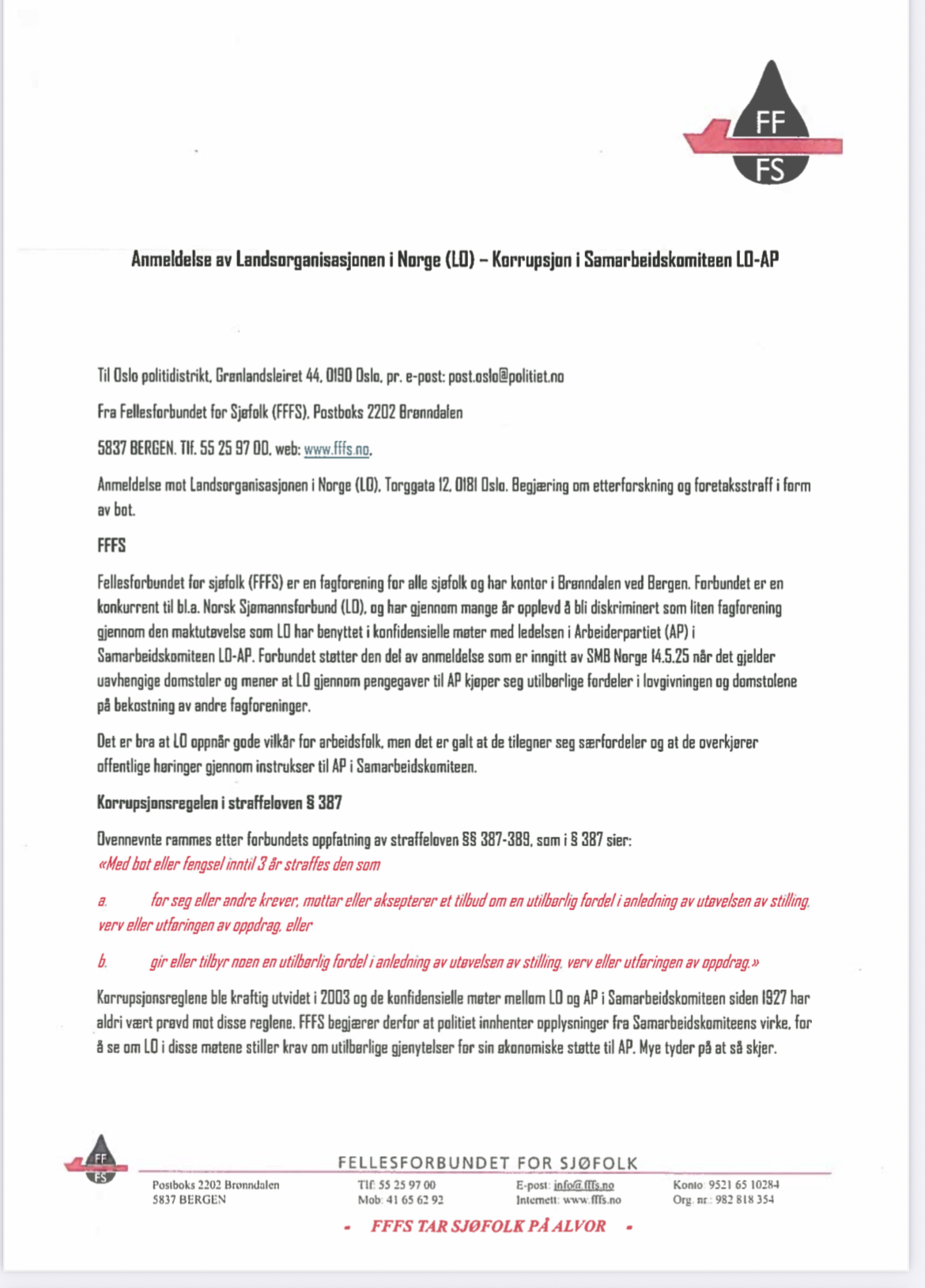
Det er åpen og kjent informasjon at LO-systemet stotter AP med mellom 20-30 millioner

kroner i partistotte, se vedlegg s. 2.

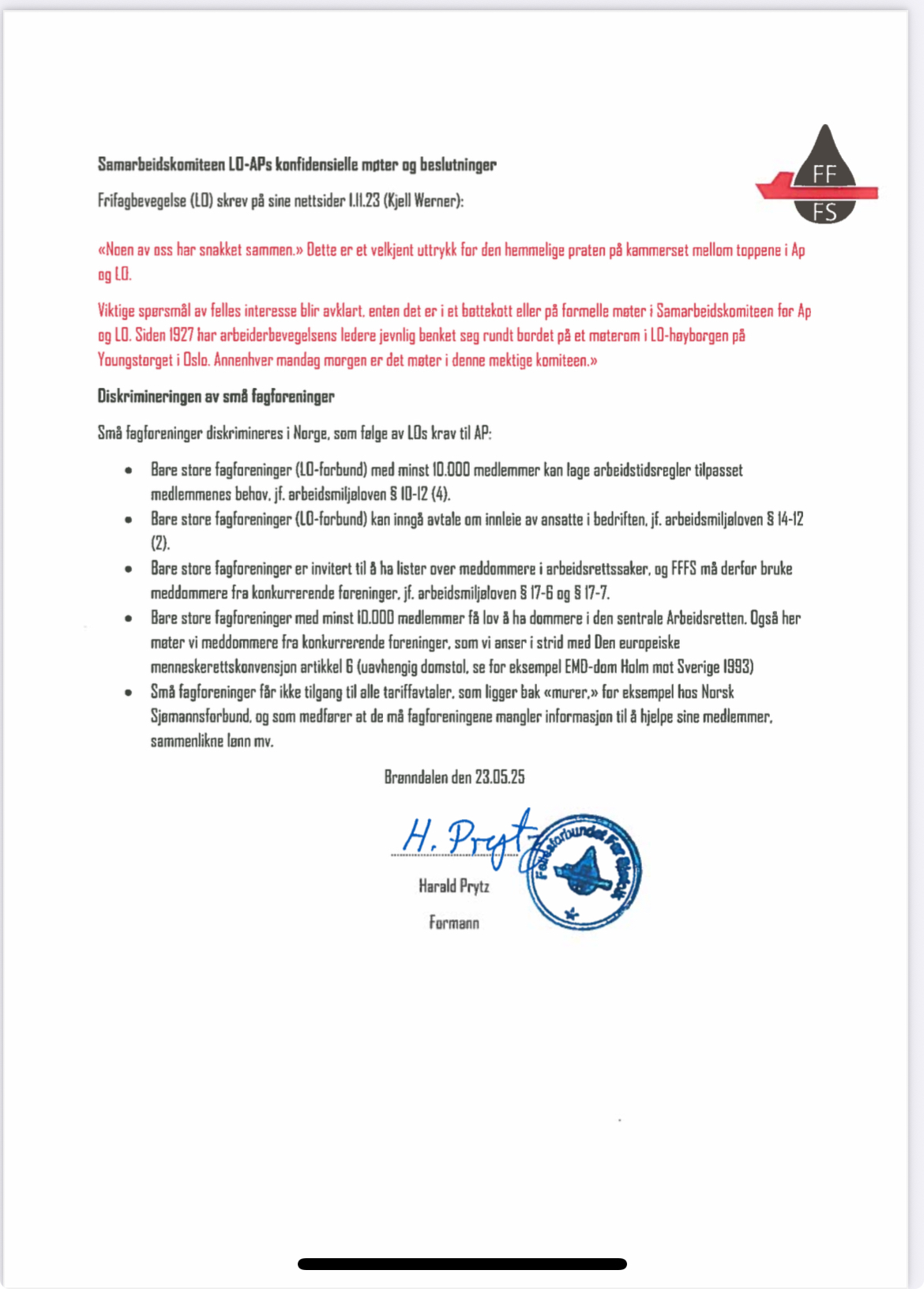
Det som er mindre kjent er at ledelsen i AP møter hos ledelsen i LO mandag hver 14. dag i

Folkets Hus i Oslo, hvor gjenytelser for partistøtten ser ut til å være tema, se vedlagte s. 3 fig.

fra boka «Noen har snakket sammen,»202 1 på LOs eget forlag, Res Publica.

Møtene i Samarbeidskomiteen skjer bak lukkede dører, og FFFS ber om at politiet innhenter

referatene fra møtene i tiden juni 2021 til juni 2022, og avhorer Peggy Hessen Følsvik (tidl

leder) og Sissel Skoghaug (tidl. nesteleder) fra LO og statsminister Jonas Gahr Store og 1-ladia

Tajik (tidl. Nestleder og arbeidsminister) fra LO. Det bør avklares om lovvedtakene mot

bemanningsbyråene i Norge, initiert av LO, har vært en gjenytelse på bakgrunn av partistotte.

Det bes i den sammenheng å se etter om diskrimineringen av mindre fagforeninger,jf.

arbeidsmiljoloven § 14-12 (2), kravet om minst 10.000 medlemmer for å leie inn personell,

også kommer frem i etterforskningen.

Mange bemanningsforetak har gått konkurs, mange arbeidstakere har mistet jobben.

Bergen 10.7.25

På vegne av FFFS

4) I,—

Harald P’

Formann.

Se oversikt over vedleggene side 2

FELLESFORBUNDET FOR SJØFOLK

I’oslhoks 2202 Bronndalcn TIf: 55259700 E-post: info&1ff%.nO Konlo. 952165 10284

5837 BERGEN Mob 41 656292 Inlemett: wv.wfffs.no Org nr.: 982 818 351

– FFFS TAR SJOFOLKPÅALVOR4

Vedleggene til klage over henleggelse av anmeldelse mot LO/Samarbeidskomiteen LO

AP for korrupsjon.

Vedlegg. 1. 2025.05.14 Anmeldelse for korrupsjon SMB Norge.

Vedlegg. 2. 2025.05.23 Anmeldelse av LO for korupsjon. FFFS.

Vedlegg. 3. 2025.06.16 Politiet. Anmeldelsen er nå registrert hos politiet.

Vedlegg. 4.2025.06.16 Politiet. Saken erhenlagt

Vedlegg. 5 Artikler media etc.

Vedlegg. 6– Millioner til AR Noen av oss har snakket sammen.

Vedlegg. 7 Med et pennestrok er ikke arbeidsplassen verdt noe. Svane Bemanning AS.

2025.07.10 Klage til statsadvokaten-Riksadvokaten.


Vedlegg. 1. 2025.05.14 Anmeldelse for korrupsjon SMB Norge


Vedlegg. 2. 2025.05.23 Anmeldelse av LO for korrupsjon. FFFS


Vedlegg. 3. 2025.06.16 Politiet. Anmeldelsen er nå registrert hos politiet.

Vedlegg. 4. 2025.06.16 Politiet. Saken er henlagt


Vedlegg. 5 Artikler media etc.


Vedlegg. 7 Med et pennestrøk er ikke arbeidsplassen verdt noe. Svane Bemanning AS